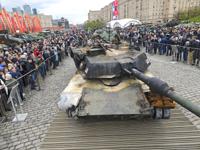
Turret 6752-UKR · Berdychi, Ukraine · Lost 2024.03.05
360° Photogrammetry Scan
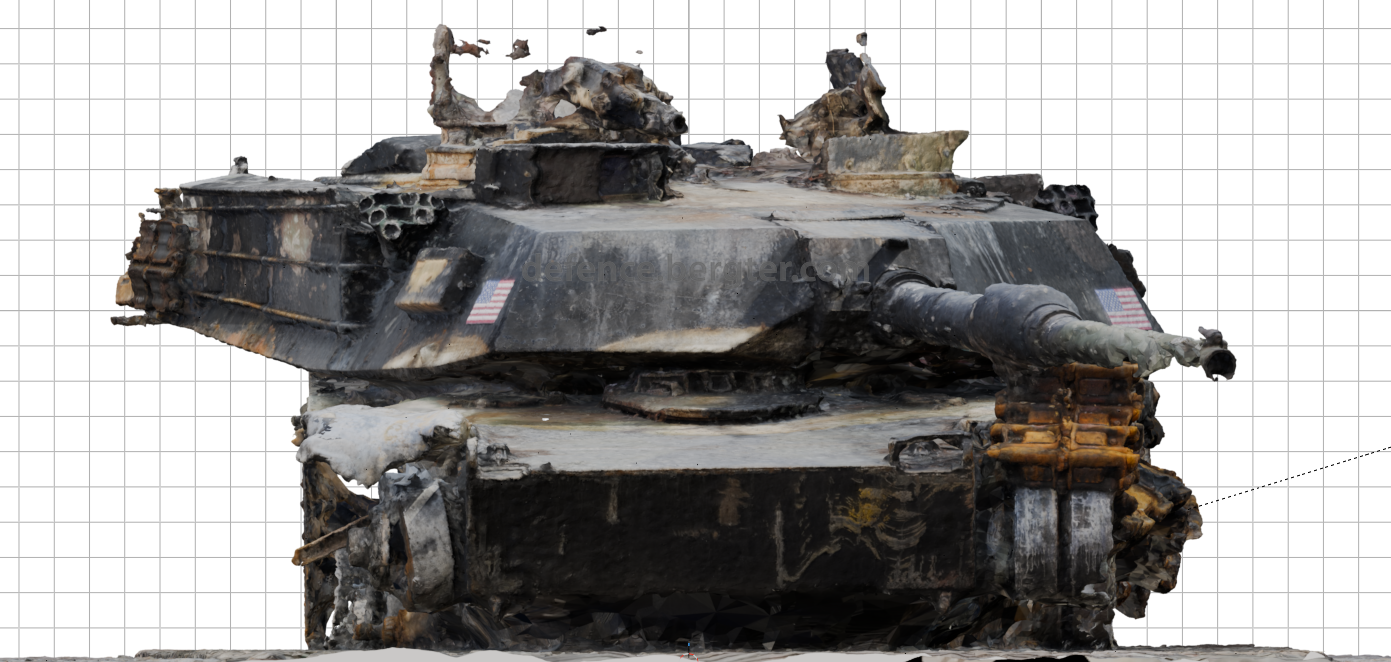
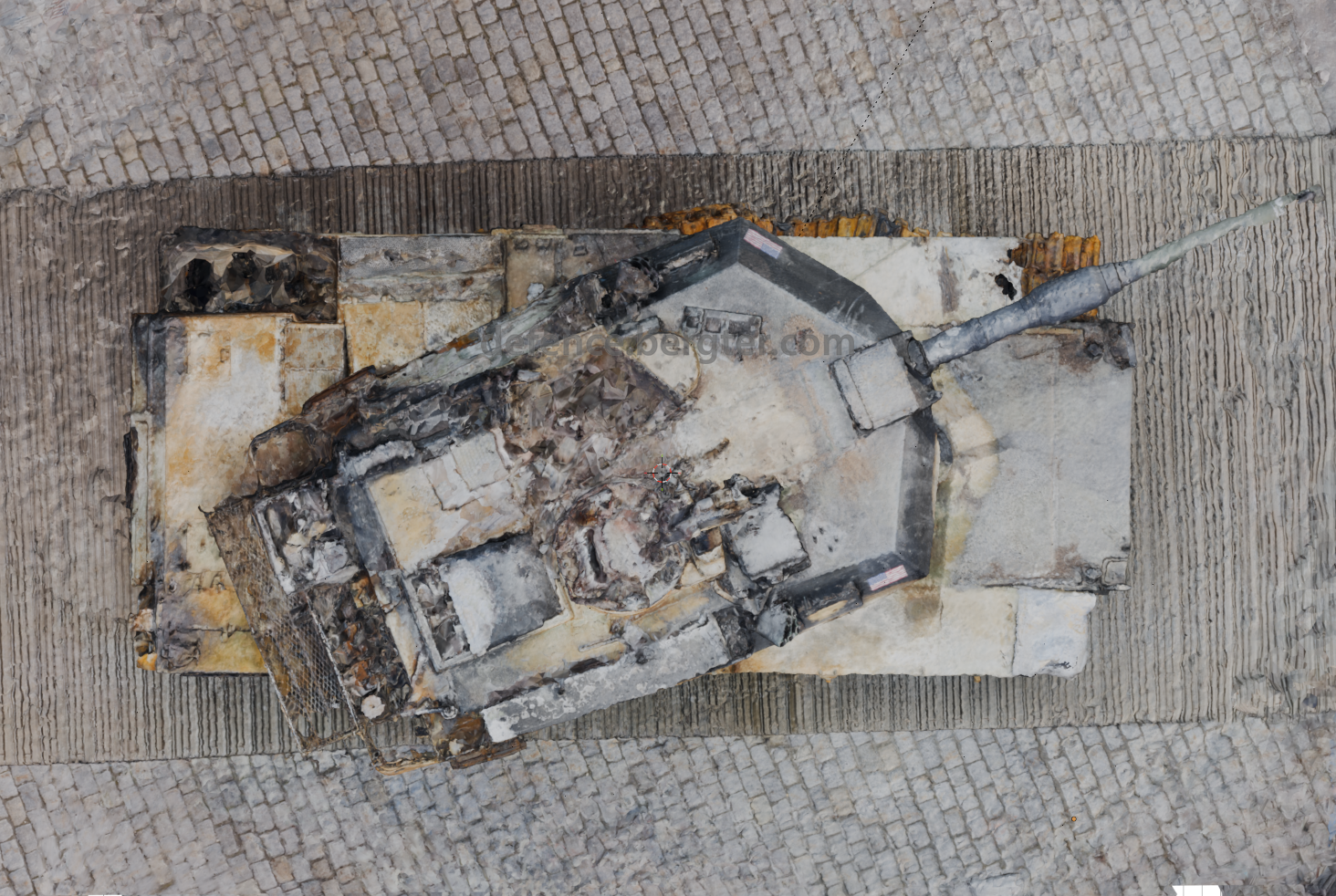
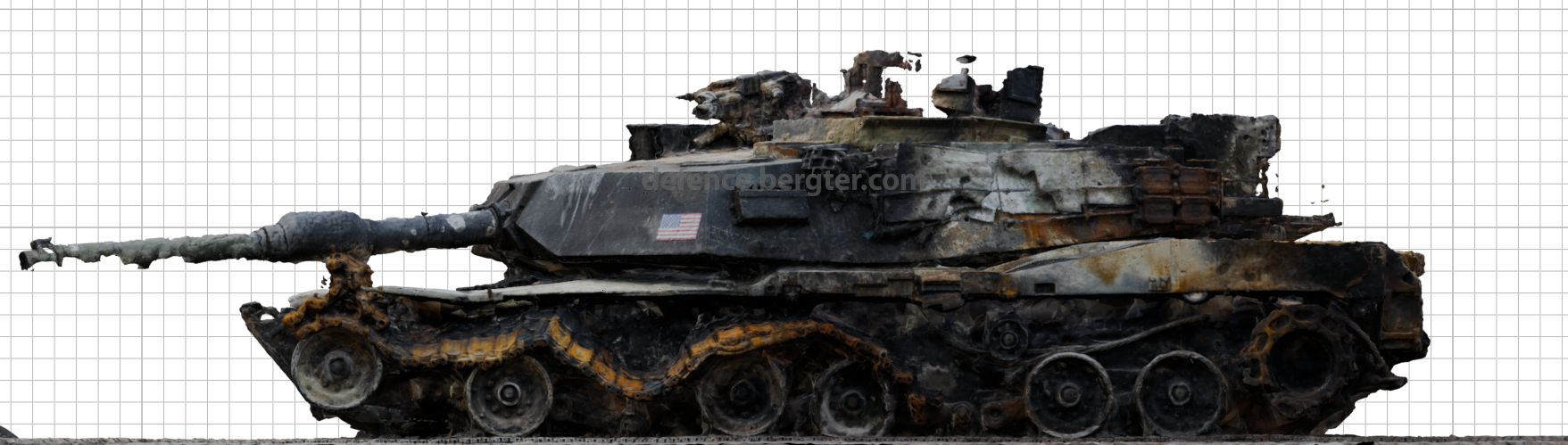
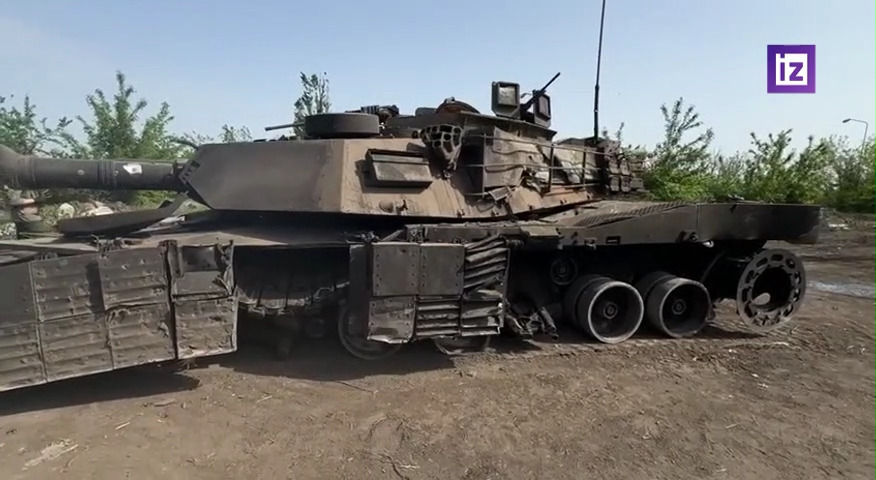
This high-resolution 360° photogrammetry scan captures the M1A1 SA Abrams, turret number 6752-UKR, in full three-dimensional detail. The scan was produced from imagery collected during the tank's public display at Poklonnaya Gora, Moscow, in May 2024.
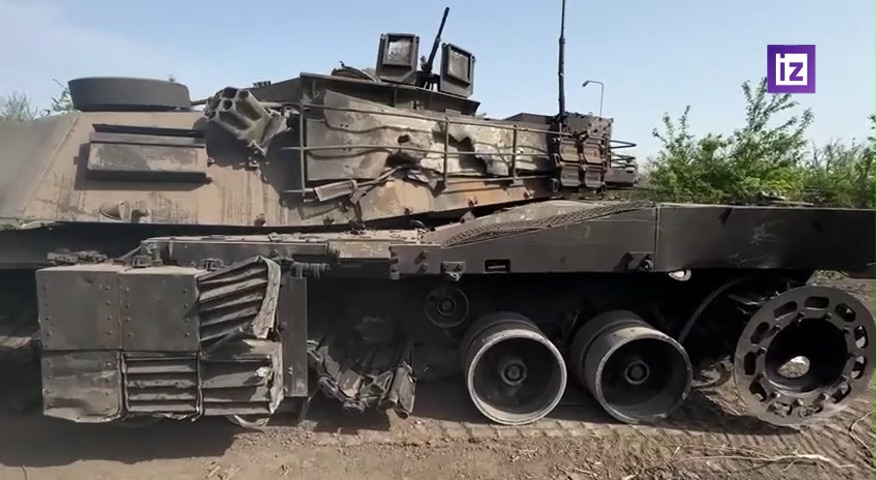
The model preserves surface-level battle damage in full geometric detail, including impact deformation, missing ERA tiles, and the burned-out interior visible through open hatches. A unique primary source for armour researchers, defence analysts, and 3D artists requiring accurate reference geometry.
Frontal viewTop-down view
Side profile
Background
The Fall of Avdiivka, February 2024
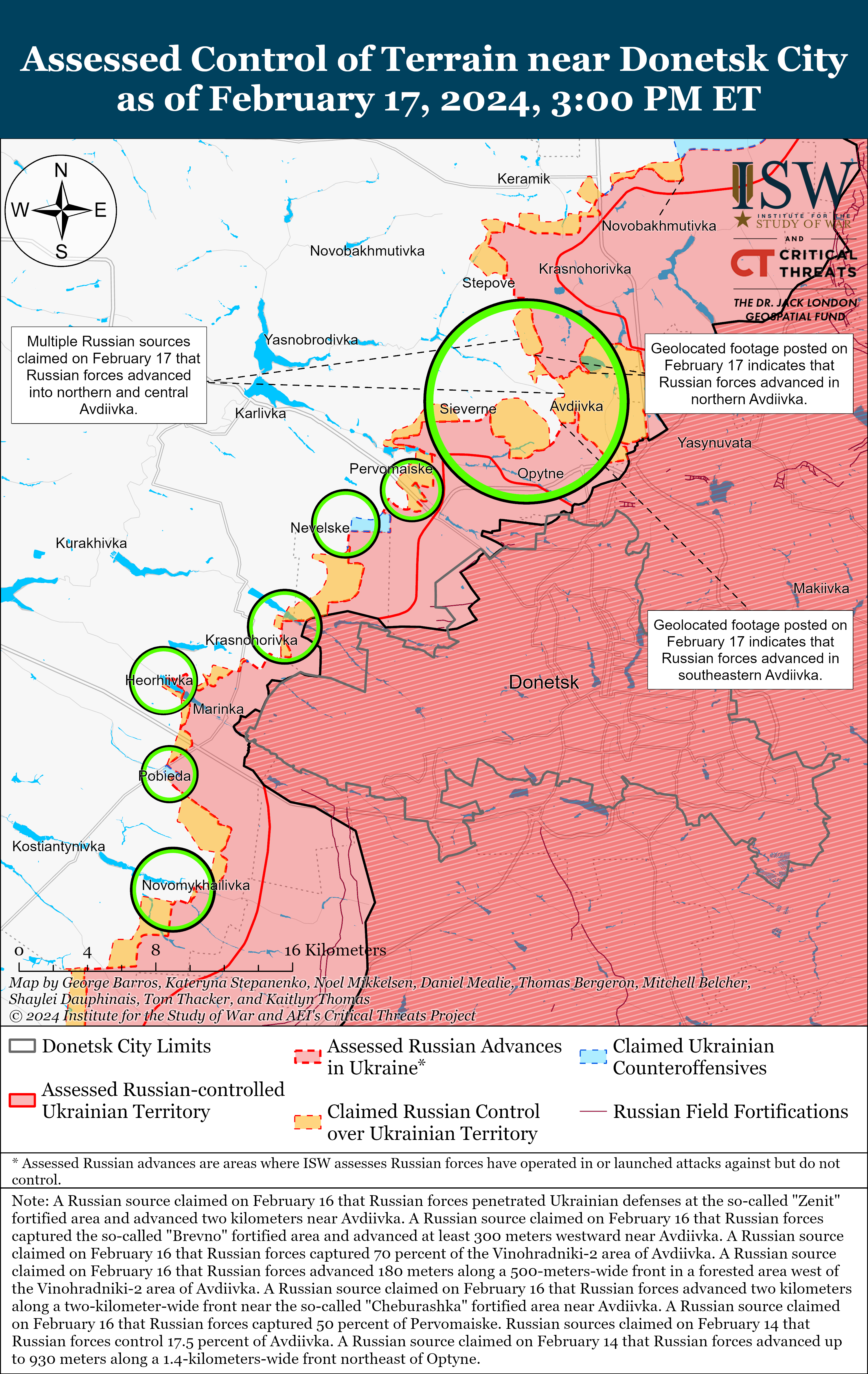
Russia had committed roughly 50,000 personnel to the Avdiivka axis, conducting a months-long tactical turning movement that progressively cut the city's supply routes. By 15 February 2024 Russian forces had severed the last road connecting southern and northern Avdiivka and were advancing on the southern outskirts of the Avdiivka Coke Plant. Avdiivka fell on approximately 17 February 2024.
The cost to Russia was enormous. By 22 February, Ukrainian military analyst Col. Petro Chernyk calculated Russian losses in the Avdiivka campaign at approximately 364 tanks and 748 armored vehicles, roughly one division's worth of tanks and two divisions' worth of AFVs. This catastrophic armored attrition would directly shape how Russian forces fought in the weeks that followed.
Avdiivka & Donetsk City, 17 Feb 2024. Russian forces had completed the tactical encirclement, cutting all primary ground lines of communication into the city. Source: ISW.
The Collapse West of Avdiivka, February 26–27
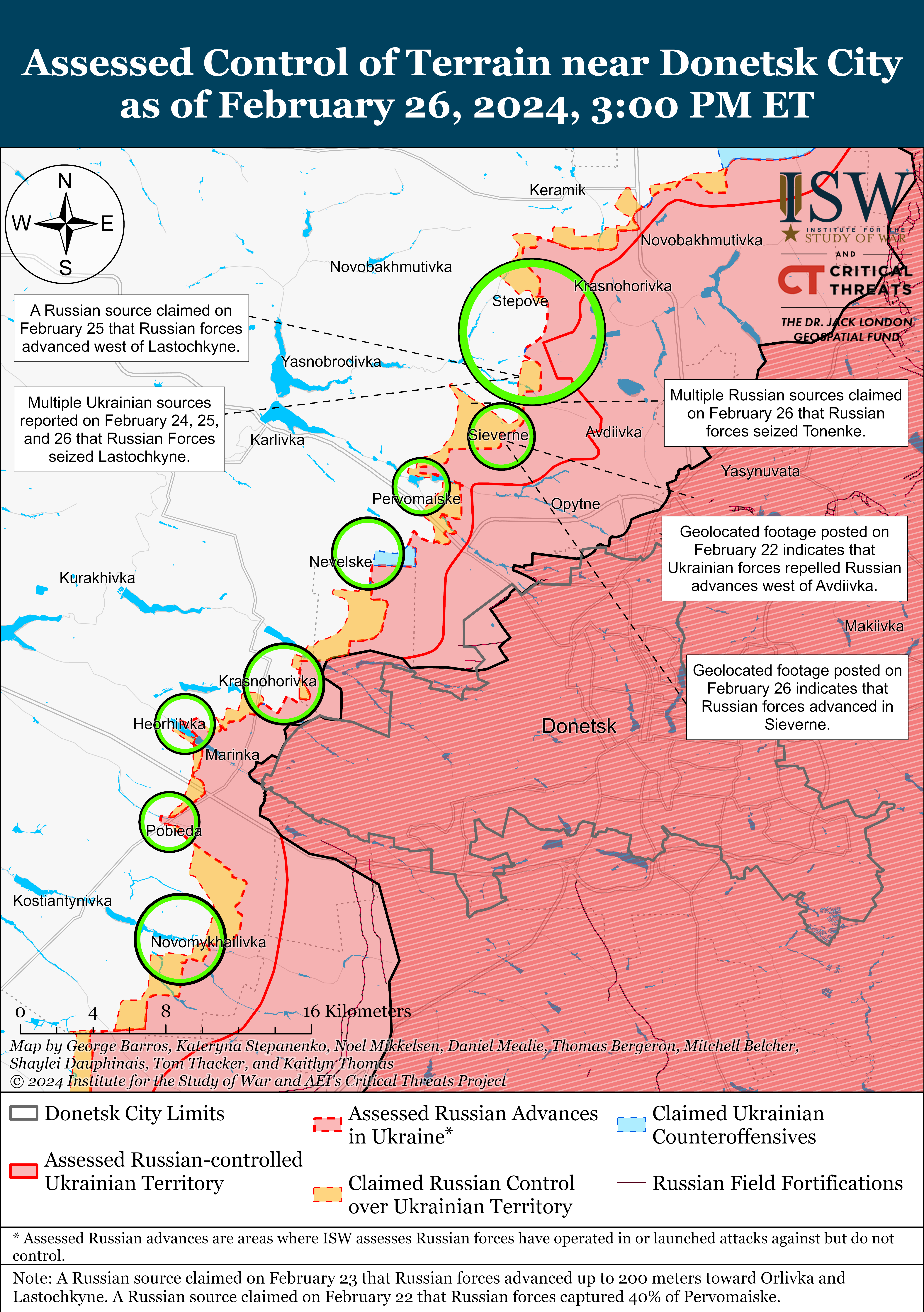
After the fall, Russian forces maintained a deliberately high operational tempo aimed at preventing Ukraine from establishing a new defensive line before it could be properly fortified. Settlements fell in rapid succession: Lastochkyne (west of Avdiivka) fell 26 February; Sieverne and Stepove (northwest of Avdiivka) both fell overnight on 26–27 February, the latter confirmed by geolocated footage of Russian 15th MRB soldiers in western Stepove.
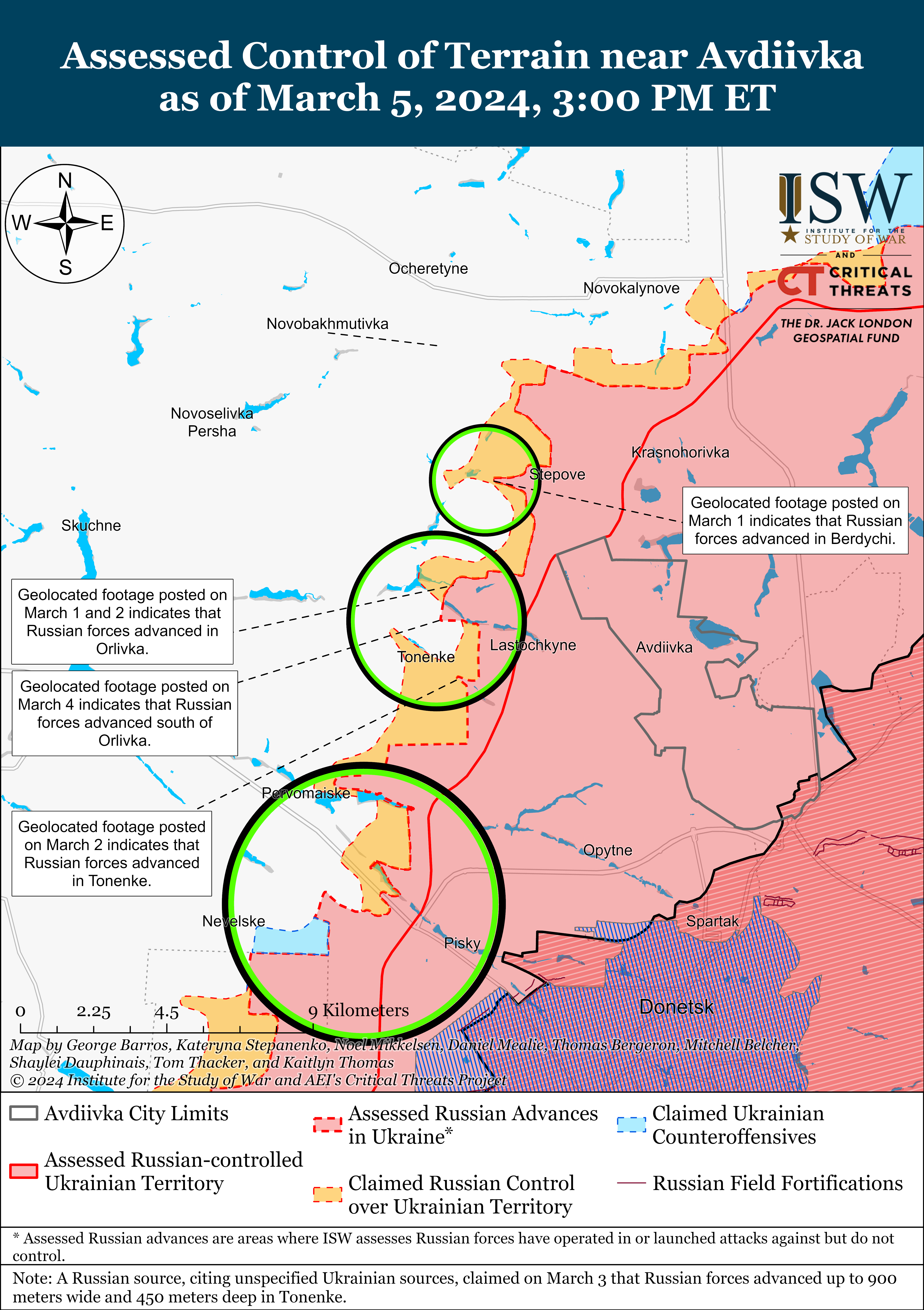
Ukrainian Tavriisk Group spokesperson Dmytro Lykhoviy announced on 26 February that Ukrainian forces had withdrawn from Lastochkyne and were establishing defensive positions on the Orlivka–Tonenke–Berdychi line, running northwest to southwest of Avdiivka. Ukrainian military observers immediately described the fortifications as "disappointing" and "problematic." Russian milbloggers predicted Ukraine would be forced to fall back further west to a line whose construction had only begun in November 2023.
Avdiivka & Donetsk City, 26 Feb 2024. Lastochkyne, Sieverne, and Stepove fell overnight as Russian forces pushed west at high tempo before Ukrainian defences could consolidate. Source: ISW.
The Berdychi Defensive Line
The new line was holding in name only. Lykhoviy confirmed as late as 5 March that there was no continuous trench line, with forces still constructing defences using natural terrain and water features. Tank ditches, bunkers, and revetments had been prepared, but the line was new to its defenders who lacked the years of familiarity that had made Avdiivka defensible for so long.
One mitigating factor was a chain of reservoirs running between Berdychi, Semenivka, and Orlivka, which channeled Russian avenues of approach and gave Ukrainian defenders predictable attack corridors to cover. Assault group sizes had been escalating from squad-sized through platoon and company level to battalion tactical group size by 1 March. Over 100 Russian airstrikes per day were recorded in the broader Avdiivka direction by 5 March.
Crucially, Russian command was deliberately limiting armored vehicles in these attacks, a direct response to the ~364 tanks lost in the Avdiivka campaign itself. The assault relied on infantry waves supported by air power. Russian milbloggers also noted that some motorized rifle units lacked grenade launchers capable of defeating Ukrainian armored vehicles, and that command was operating from inaccurate maps that overestimated Russian terrain control.
West of Avdiivka, 5 March 2024. The Orlivka–Tonenke–Berdychi defensive line on the day of the Abrams loss, with active fighting at Berdychi, Semenivka, Orlivka, and Tonenke simultaneously. Source: ISW.
The 47th Brigade and the Abrams at Berdychi
Ukraine's 47th Separate Mechanized Brigade had received 31 M1A1 SA Abrams in fall 2023. With the crisis around Avdiivka more acute than the stagnant Zaporizhia front, the brigade was committed to the Donetsk direction. At Berdychi the Abrams was employed defensively rather than in massed offensive assault: anchoring an incomplete line with direct-fire support against infantry waves, in terrain partially channeled by the reservoir chain between Berdychi, Semenivka, and Orlivka.
A tank in a prepared revetment, engaging company-sized infantry formations in channeled terrain, would be highly effective against the specific threat on this axis. Infantry alone could not hold against BTG-sized assault groups backed by 100 air sorties per day. A single tank provides what dismounted infantry cannot: direct fire at range, survivability against small arms and fragmentation, and a deterrent against massed infantry.
Russian units confirmed attacking Berdychi on 5 March included the 24th Guards Spetsnaz Brigade (GRU) and the 30th Motorized Rifle Brigade (2nd Guards Combined Arms Army). GRU Spetsnaz are not typically used as line infantry. Their presence indicates Berdychi was a deliberate, high-priority Russian objective, chosen because it sat on the northern flank of the Orlivka–Tonenke axis, and its capture would unhinge the entire defensive line.
By early March 2024 the front around Avdiivka had collapsed and Russian forces were pushing north-west toward Berdychi. Ukraine's 47th Separate Mechanized Brigade, the sole Abrams-equipped Ukrainian unit, was committed to slowing the advance in this sector.
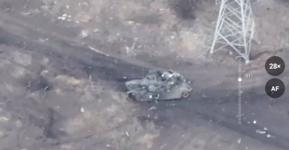
On the morning of 5 March 2024, this M1A1 SA was engaged near an overhead high-voltage power line east of Berdychi. It was struck by multiple anti-tank guided missiles (ATGMs), leaving it immobilised. A follow-up round from a Russian tank, assessed as a T-72 by open-source analysts, caused further damage to the hull. Unable to recover the vehicle under fire, the crew abandoned the tank on the field.
▶︎
▶︎
▶︎
Days after the crew's withdrawal, Russian assault groups reached the disabled Abrams and secured it. Unlike several other Abrams lost in the Berdychi fighting, this example remained largely structurally intact despite the ATGM strikes, most of the impact energy was absorbed by the ERA-equipped sideskirts. Those sideskirts were removed prior to the Poklonnaya Gora display and are therefore not represented in the 3D scan.
▶︎
Capture & Recovery by Russian Forces
Russian forces recovered the tank in the days following the engagement. Footage released in late spring 2024 showed it being towed and inspected at a Russian staging area. The 47th Brigade's official loss report confirmed the vehicle's factory number as 6752-UKR.
The tank carried a full combat load at the time of loss, including 120 mm rounds, small-arms ammunition, and crew-issued night-vision equipment, all documented by Russian forces upon capture.
▶︎
▶︎
▶︎
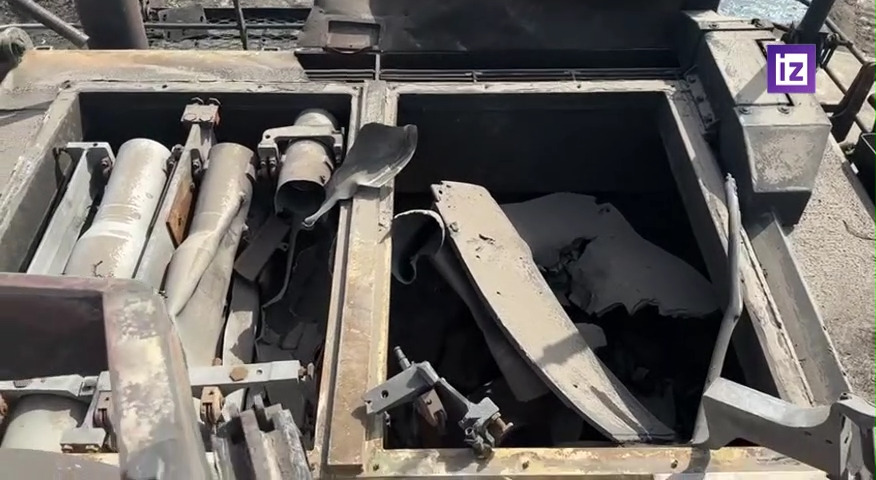
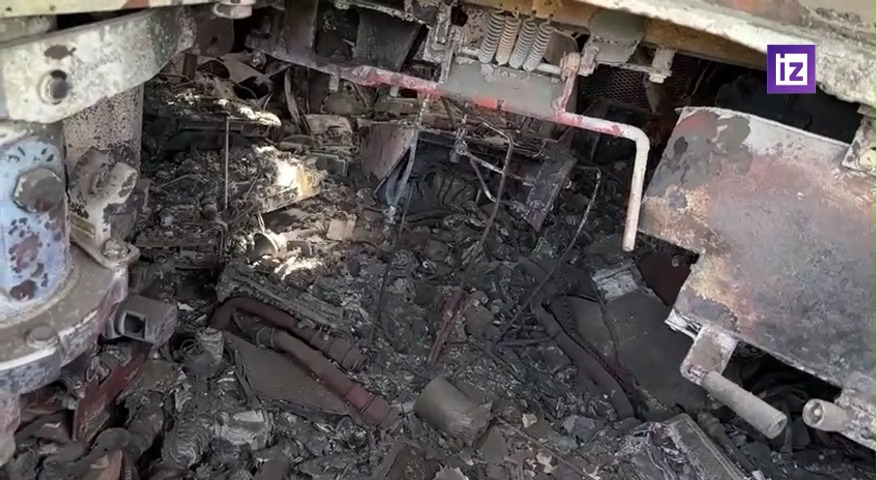
Bustle:blowout panels absent and ammunition burned out. The M1A1 SA's blowout here confirms a penetration ignited stored rounds; rounds were likely only stored on the right side, the left side appears to have been left mostly empty. View through the driver's hatch. Interior fully burned out; secondary fire following the penetration consumed the crew compartment. The crew had abandoned the vehicle before the fire took hold.
ARAT ERA tiles blown off the sideskirts at the position of the turret front, consistent with at least one ATGM detonating in that area.ARAT ERA absent across the engine deck and rear hull area. The missing tiles here may reflect additional hits, but the pattern is also consistent with tiles dislodged or stripped during recovery; the vehicle was towed by Russian forces over rough terrain before reaching a staging area.
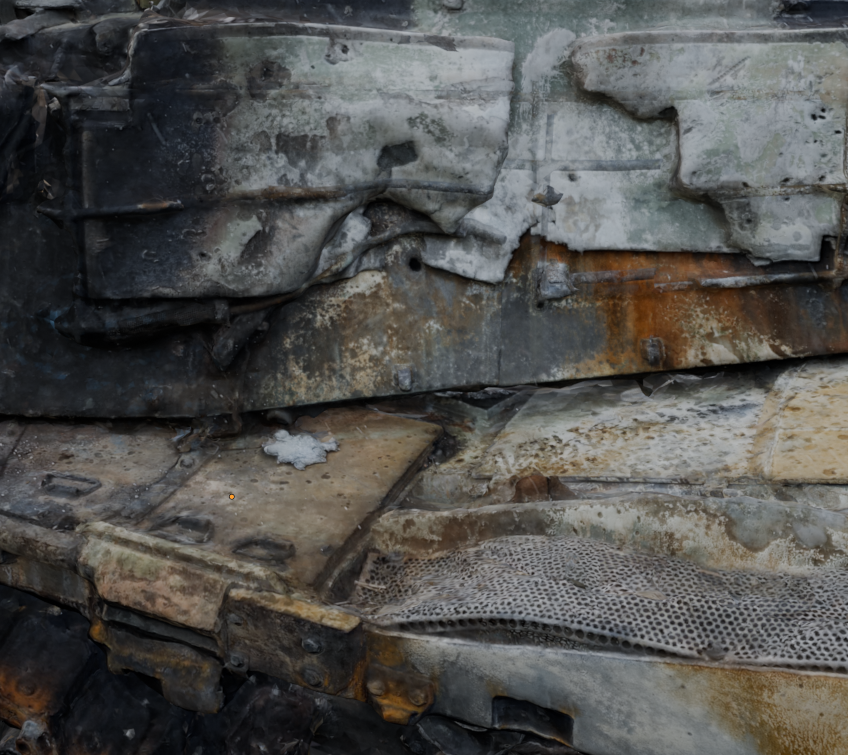
Left turret side. Impact damage visible on the scan geometry. At least one of the ATGM hits shown in the videos above is likely responsible, though the low resolution of the footage makes a definitive match difficult. Additional impacts likely occurred on the sideskirts, which are now missing. The impact point sits just forward of the internal blast wall that separates the crew compartment from the ammunition stored in the bustle. The hit likely penetrated the turret armor at this location, but the angle and position mean it was not a direct strike on the crew positions. 3D Scan closeup.
Display at Poklonnaya Gora, Moscow
In May 2024 the tank was transported to Moscow and placed on public display at Poklonnaya Gora (Victory Park), alongside a captured Leopard 2A6 and other Western equipment. The exhibition drew large crowds and received extensive coverage in Russian state media. It was at this public display that detailed external imagery used for the photogrammetry reconstruction was collected.
Vehicle at a Glance
Parameter
Value
Variant
M1A1 SA (Situational Awareness)
Turret Number
6752-UKR
Unit
47th Separate Mechanized Brigade, Ukraine
Date of Loss
5 March 2024
Location
48.19587°N 37.66202°E, Berdychi, Donetsk Oblast
Cause of Loss
ATGMs + T-72 tank fire
Final Status
Captured, on display at Poklonnaya Gora, Moscow
CDURS Rating
2 (Non-functional)
Sources
47th Separate Mechanized Brigade official loss reports (leaked), March 2024
Open-source geolocation: 48.19587°N 37.66202°E confirmed via overhead imagery